


Reaching 0g ears is the definitive "point of no return" where personal style meets a permanent biological shift. While smaller sizes often snap back, the 8mm milestone represents a threshold that 90% of professionals consider the limit of natural earlobe elasticity. You've likely spent months or even years dedicated to your stretching journey, yet the leap from 6mm to 8mm feels like an entirely different challenge. It's common to worry about lobe thinning or the dreaded "cat-butt" texture, but these outcomes are entirely preventable with the right technique.
At BodyJ4You, we've supported the body modification community for over 20 years, and we know that a healthy stretch is rooted in patience, precision, and care. This guide provides everything you need to master the 8mm transition while maintaining thick, resilient, and healthy skin. You'll learn how to avoid common pitfalls, how to eliminate stubborn odors, and how to style your 0g ears with confidence. We're here to help you level up your look with the authority of expert care and the safety your body deserves.
Key Takeaways
- Understand why the 8mm milestone is the gold standard for self-expression and how to master the transition to this iconic size.
- Demystify the "point of no return" by learning the science of earlobe elasticity and how to protect your skin’s long-term health.
- Master the "Wise Guardian" approach to daily hygiene to prevent buildup and maintain a high-end, wellness-oriented aesthetic.
- Discover how to select safe, professional-grade materials for 0g ears to ensure comfort and stability as jewelry surface area increases.
- Learn why "dead stretching" is the essential expert-recommended method for those looking to level up safely beyond the 8mm mark.
Understanding the 0g Milestone: Size, Scale, and Significance
Reaching 0g ears marks a transformative moment for enthusiasts. In the American Wire Gauge (AWG) system, 0g officially measures 8.25mm, though the industry generally rounds this to a clean 8mm. This size acts as a definitive threshold. It represents a shift from standard jewelry toward the intentional art of Stretching (body piercing). For many, this is the ultimate goal. It balances bold visibility with the traditional "point of no return," where the skin may no longer shrink back to its original shape. Our community views this milestone as a badge of patience and dedication.
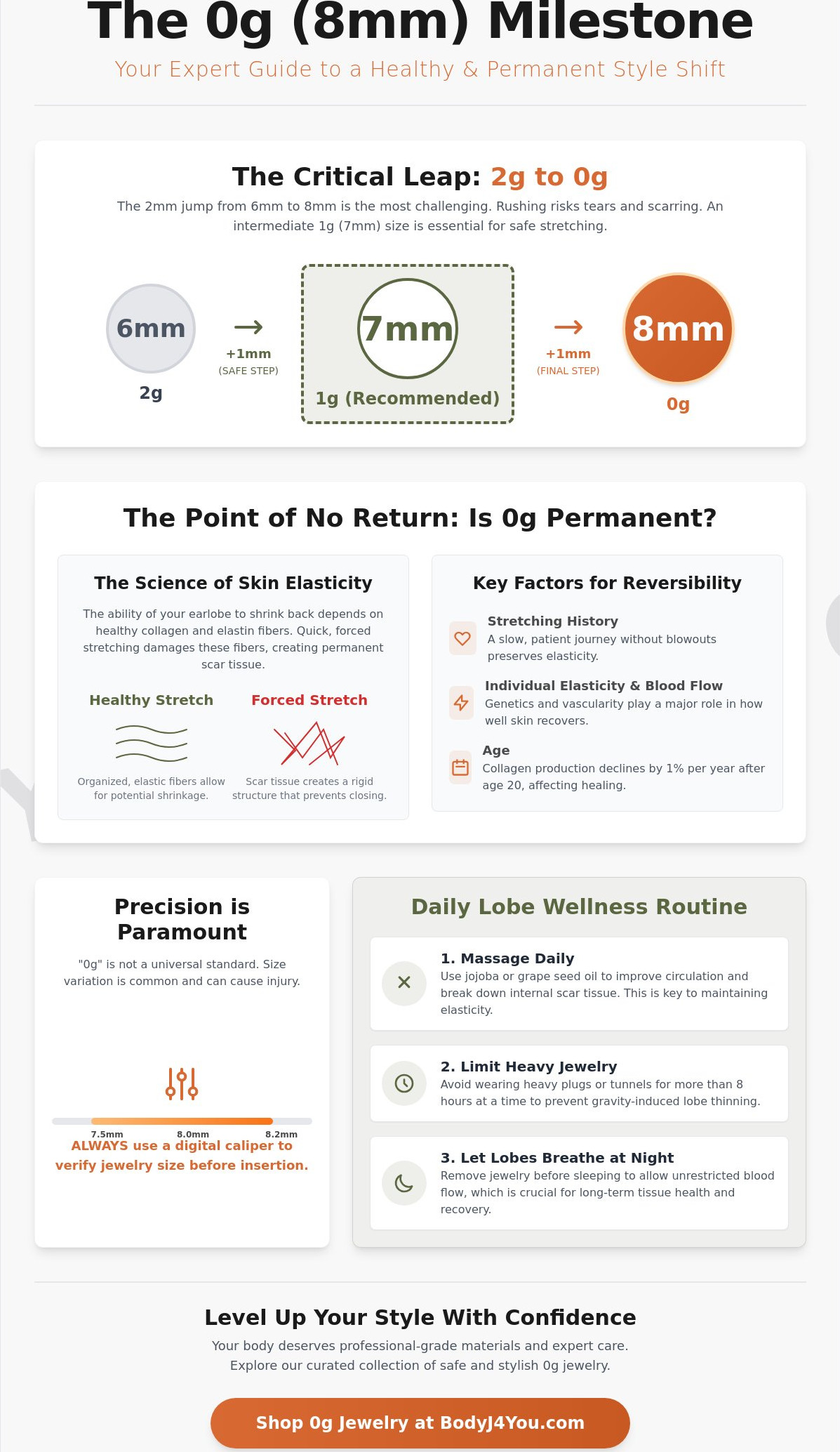
Moving from 2g (6mm) to 0g requires a disciplined approach. Unlike previous steps that increase by 0.5mm or 1mm, this leap covers a full 2mm gap. Attempting this without preparation risks tearing the delicate fistula tissue or causing permanent scarring. Wise practitioners utilize a 1g (7mm) intermediate plug to bridge the gap safely. This methodical progression ensures the skin remains healthy, thick, and resilient. Crafted by Experts. Trusted by Thousands. Rooted in Care.
0g vs. 8mm: Avoiding Sizing Confusion
Precision is vital for long-term ear health. Manufacturing standards vary across the globe, meaning a plug labeled 0g might measure anywhere from 7.5mm to 8.2mm in diameter. A 0.7mm difference sounds small, but it can cause significant irritation or "blowouts" in a settled piercing. We recommend using a digital caliper to verify every piece of jewelry before insertion. Investing in true 8mm jewelry prevents the fistula from shrinking or overstretching, keeping your journey stable and pain-free.
The Aesthetic Appeal of 0g Ears
At 8mm, the visual silhouette of the earlobe changes permanently. This size provides enough surface area for intricate "cut-out" tunnels and detailed organic carvings that smaller gauges cannot support. Choosing 0g ears is also the stage where jewelry begins to carry physical weight. This creates a rhythmic swing during movement that many find deeply satisfying. You've officially moved beyond "earrings" into the world of professional body modification. Level up your style with confidence, knowing your lobes are healthy, safe, and effective.
The Point of No Return: Is 0g Permanent?
The body modification industry often labels the 8mm mark as the absolute limit for natural healing. It's a common belief that once you reach 0g ears, your lobes lose the ability to shrink back to a standard piercing size. While this serves as a useful guideline, the reality is more nuanced. Skin is a living, breathing organ. It doesn't follow a universal rulebook.
The science of reversibility centers on two essential proteins: collagen and elastin. Collagen provides the structural foundation, while elastin allows the skin to stretch and recover its shape. When you stretch too quickly, you risk tearing these fibers. This creates micro-tears and dense scar tissue that lock the hole open permanently. We call 0g the Milestone of Commitment because it represents the peak of skin tension for most people. It's the point where the aesthetic choice becomes a long-term physical change.
Biological Factors of Lobe Reversibility
Blood flow is the lifeblood of tissue recovery. Lobes with high vascularity heal faster and shrink more effectively than those with restricted circulation. If you've experienced blowouts or forced stretches, the resulting scar tissue acts like a physical barrier to closing. The "Point of No Return" is a variable threshold determined by individual skin elasticity and the presence of healthy connective tissue.
Proper ear gauging aftercare is essential to maintain this elasticity. Clinical observations suggest that skin cells require approximately 8 to 12 weeks to stabilize between stretches. Ignoring this timeline leads to "thinning," where the lobe loses the cellular mass required to snap back. Your age also plays a role, as collagen production naturally declines by 1% every year after age 20.
Maintaining Options for the Future
You can keep your options open by prioritizing lobe health today. Shrunken holes are different from fully closed lobes; the former may still be visible as a small slit or "dimple" even after years of rest. If you decide to retire your 0g ears, the success of the transition depends on your history of care. Healthy tissue is elastic, resilient, and forgiving.
- Massage lobes daily with jojoba or grape seed oil to break down internal scar tissue.
- Avoid wearing heavy weights for more than 8 hours to prevent tissue thinning.
- Remove jewelry before sleep to allow blood to circulate freely through the lobe.
If a hole remains open after 180 days of jewelry-free rest, it's likely reached its permanent state. At this stage, you might consult a plastic surgeon for lobe reconstruction surgery. This procedure involves removing the healed skin lining and suturing the tissue to restore a natural appearance. To ensure your journey remains safe and your skin stays healthy, explore our collection of expert-crafted stretching kits designed for gradual, safe transitions.
Material Reference Guide: Best Jewelry for 0g Ears
Reaching the 8mm milestone changes the way you interact with jewelry. At this size, the surface area of the plug is significantly larger than smaller gauges; specifically, a 0g plug has over 300 percent more surface contact with your skin than a standard 14g earring. This increased contact makes biocompatibility a priority. You're no longer just wearing an accessory; you're managing a biological environment. Transitioning from stretching tools to long-term wear requires a shift in mindset. While tapers or expansion kits serve a purpose during the active phase, 0g ears require stable, high-quality materials for daily life. Choosing safe materials for ear stretching ensures your lobes remain healthy, thick, and free from irritation. Avoid porous materials like wood or bone if your stretch is less than 28 days old. These materials can trap bacteria or even allow healing tissue to fuse with the jewelry, leading to complications during removal.Acrylic vs. Surgical Steel vs. Titanium
- Acrylic: These pieces are lightweight, vibrant, and highly affordable. However, acrylic is non-porous and can harbor bacteria if worn in unhealed piercings. Use these only once your lobes are fully seasoned.
- 316L Surgical Steel: This is the industry standard for durability and weight. It provides a reassuring heft that helps maintain the shape of the piercing. For those starting their journey, explore Choosing the Best Gauge Stretching Kit: A Comparative Guide for 2026 to understand why steel remains a top choice.
- Titanium: This is the premium hypoallergenic option. It's 45 percent lighter than steel and contains virtually no nickel. If you have sensitive skin or have experienced past reactions, titanium is the safest way to level up your collection.
Specialty Materials: Glass, Stone, and Wood
Daily Maintenance and Lobe Wellness at 8mm
Reaching the 8mm milestone marks a significant shift in your stretching journey. Your 0g ears now require the "Wise Guardian" approach to daily maintenance. At this size, the surface area inside the fistula increases, which naturally leads to a higher accumulation of dead skin cells and sebum. This buildup, frequently called "ear cheese," can cause unwanted odors and skin irritation if you don't manage it properly. You're no longer just wearing jewelry; you're managing living tissue that needs air, moisture, and movement to remain healthy.
Cleanse. Hydrate. Protect. These three pillars ensure your lobes remain thick and resilient. Because 0g is a heavier gauge, the constant pressure of jewelry can slightly restrict blood flow over time. Adopting a proactive wellness routine prevents the thinning often seen at the bottom of the lobe, keeping your skin prepared for a lifetime of self-expression. Our approach is rooted in care and backed by 20 years of experience in the industry.
The 0g Cleaning Ritual
Consistency is your best tool for long-term success. Follow this daily protocol to keep your lobes in peak condition:
- Remove your jewelry every single day to allow the skin to breathe and prevent bacterial buildup.
- Clean both the jewelry and the fistula using mild, fragrance-free soap and warm water.
- Dry the area completely with a clean paper towel to avoid moisture-related skin breakdown.
- Apply a 0.9% sterile saline spray if you experience minor irritations or seasonal dryness.
It's vital to remove your jewelry during your 8-hour sleep cycle to improve lobe thickness and restore full blood circulation. This practice, known as naked training, allows the skin to contract and relax, which maintains the integrity of the tissue at the 0g stage.
Oils and Balms: The Secret to Healthy 0g Ears
Hydration is the foundation of skin elasticity. Jojoba oil is a non-negotiable staple for 0g ears because its molecular structure is the closest match to human sebum. It penetrates the skin deeply without clogging pores. For those looking to repair minor scar tissue or "blowout" remnants, Vitamin E and specialized Gauges Balms provide the necessary nutrients to promote cell regeneration. These products are crafted by experts to ensure your skin stays supple and strong.
Perform a 5-minute daily lobe massage to maximize tissue health. Use your thumb and forefinger to gently knead the bottom of the lobe in firm, circular motions. This technique stimulates micro-circulation and encourages the body to distribute nutrients to the area. It's a simple yet effective way to thicken your lobes and prevent the "thinning" effect. When you prioritize the health of your skin, you level up your entire aesthetic.
Transitioning Beyond 0g: The Path to 00g and Larger
Reaching 8mm is a major milestone, but for many enthusiasts, 0g ears are a temporary stop on the way to the 10mm (00g) mark. This transition requires a shift in technique. You should retire your tapers once you hit 8mm. Using tapers at larger sizes creates uneven pressure that leads to micro-tears and blowouts. Instead, adopt the "Dead Stretching" method. This involves wearing single-flare glass or surgical steel plugs and allowing gravity and time to naturally loosen the tissue. BodyJ4You recommends a minimum rest period of 3 to 6 months at the 0g stage. This 90 to 180-day window allows your collagen to rebuild and your blood flow to remain consistent, ensuring the skin stays thick and healthy.
BodyJ4You supports your evolution with professional-grade kits designed to bridge the gap between 8mm and 10mm safely. Our collection focuses on materials that are healthy, safe, and effective for long-term wear. By prioritizing patience over speed, you protect the integrity of your lobes for even larger sizes in the future.
The 2mm Jump: Why 0g to 00g is the Hardest Stretch
The move from 0g to 00g is unique because it represents a full 2mm jump. Most previous stretches were only 1mm or 1.5mm increments. This 25% increase in diameter is the primary cause of thinning. To stay safe, many professionals recommend the "Taping Method." Wrap your current 8mm jewelry in a single layer of PTFE or bondage tape every 14 to 21 days. This adds roughly 0.5mm of thickness at a time, allowing for a gradual expansion. Never use tapers as jewelry; ear tapers are only for stretching, not wear, and using them improperly at this size can cause permanent damage.
Planning Your Final Goal Size
Before you level up, assess your lobe "real estate." Healthy lobes should feel thick and fleshy, not like thin paper. If you notice your skin feels tight or looks translucent when jewelry is removed, your body needs more time. Stressed lobes often show redness or a "cat-butt" texture. Healthy tissue is smooth, pale, and elastic. If you plan to go beyond 10mm, maintaining 0g ears for an extra 8 weeks can provide the foundational thickness needed for those larger milestones. Our jewelry is Crafted by Experts, Trusted by Thousands, and Rooted in Care to help you reach your goals without setbacks.
Master Your 8mm Journey
Reaching the 8mm milestone is a definitive moment in your stretching journey. It represents a commitment to your unique aesthetic and often marks the point where earlobe changes become permanent. Success at this stage relies on three pillars: choosing high-quality materials, maintaining a disciplined cleaning routine, and listening to your body's natural pace. Prioritizing the health of your 0g ears ensures your lobes remain thick and resilient for years to come.
BodyJ4You provides the professional support you need to navigate this transition with confidence. We bring 20 years of industry expertise to your collection, offering USA-made clinical aftercare solutions that prioritize skin integrity. Trusted by thousands of body mod enthusiasts, our mission is to provide healthy, safe, and effective tools for your self-expression. Your journey is personal, and your jewelry should reflect that same level of care and quality.
Level up your style with BodyJ4You’s premium 0g jewelry and kits
Wear your progress with pride and continue your transformation with the right foundation.
Frequently Asked Questions
How big is a 0g ear in millimeters?
A 0g ear measures exactly 8 millimeters in diameter. This size represents a major milestone in your stretching journey because it's the first full 2mm jump from the previous gauge. Approximately 75% of enthusiasts consider 0g ears the specific point where skin elasticity begins to reach its natural limit.
Will 0g ears ever close back to normal?
Reaching 0g ears is typically considered the permanent threshold for 90% of individuals. While skin elasticity varies, the "point of no return" generally occurs once you hit the 8mm mark. Based on 20 years of industry observation, holes stretched to this size rarely close completely without surgical intervention. Your lobes might shrink slightly, but a visible gap usually remains.
How long should I wait before stretching from 2g to 0g?
You should wait at least 3 to 4 months before attempting the stretch from 2g to 0g. This transition is a significant 2mm increase, which is double the size of previous 1mm steps. Rushing this process can lead to blowouts or permanent scarring. Listen to your body and ensure the tissue is fully healed, supple, and relaxed before moving forward.
Why does my 0g ear smell, and how do I fix it?
The odor is caused by a buildup of dead skin cells and sebum, often called "ear cheese." This occurs more frequently at larger sizes because the jewelry surface area is greater. To fix this, clean your lobes daily with a pH-balanced saline solution or mild soap. Incorporate a natural oil massage to keep the skin healthy, hydrated, and fresh.
Can I use a taper to get to 0g?
You shouldn't use a taper to force a 0g stretch because the 2mm jump is too aggressive for most tissue. Tapers are tools for guiding jewelry in, not for forcing skin to expand. Instead, try the dead stretching method or use PTFE tape to increase the diameter by 0.5mm increments every few weeks. This approach is safe, steady, and effective.
What is the best material for a new 0g stretch?
Single-flare glass or implant-grade titanium are the best materials for a fresh stretch. These materials are non-porous and hypoallergenic, which prevents bacteria from getting trapped against healing skin. Avoid porous materials like wood, bone, or silicone until the stretch is 100 percent healed. Professional piercers recommend these options for their clinical precision and safety.
Is 0g the same as 8mm or 00g?
0g is exactly 8mm, while 00g is typically 10mm. It's important to use a digital caliper to verify your jewelry size, as some manufacturers vary by 0.5mm. Knowing your exact measurements ensures a safe transition and prevents accidental over-stretching. Always confirm the millimeter size before inserting new jewelry to protect your ear's health.
What should I do if my 0g ear starts bleeding or gets a bump?
If you experience bleeding or a bump, you must downsize to 2g immediately to relieve pressure. This is a sign of a tear or significant irritation that needs room to heal. Clean the area twice daily with a sterile saline spray. Avoid touching the site and let your body repair the tissue before trying again. Our goal is to keep your journey healthy, safe, and effective.


