

Did you know that 31% of people with body piercings report complications during their healing journey? When it comes to a sensitive area like the nipple, the stakes for your self-expression feel even higher. You might feel frustrated by painful crusty buildup or confused by the conflicting advice surrounding DIY salt ratios versus professional sprays. It's a common worry, and you deserve a recovery process that feels as empowering as the piercing itself.
This guide will teach you to master the science of your nipple piercing salt solution to ensure your skin heals beautifully without irritation or bumps. We'll show you how to maintain your aesthetic with clinical precision, reducing swelling and preventing the infections that affect up to 20% of new piercings. You'll learn the official aftercare standards for 2026, including why the Association of Professional Piercers recommends a sterile 0.9% sodium chloride solution over homemade mixtures. We'll also provide a clear daily routine to support your body through the six to twelve month healing phase, keeping your new look healthy, safe, and effective.
Key Takeaways
- Understand why a precise 0.9% sodium chloride concentration in your nipple piercing salt solution is essential for protecting delicate skin from chemical burns.
- Learn a structured five-step protocol to effectively irrigate the piercing site while preserving the natural lipids necessary for a beautiful finish.
- Identify the subtle differences between granulomas, keloids, and infections to maintain a clear, irritation-free aesthetic throughout your healing journey.
- Discover how to use saline-osmosis to reduce swelling and manage the unique friction challenges presented by daily wear and clothing.
- Level up your aftercare with expert-crafted methods rooted in twenty years of clinical safety and body modification expertise.
The Critical Role of Nipple Piercing Salt Solution in Healing
Nipple piercings are a powerful act of self-expression. They also represent a unique physiological challenge for your skin. Unlike the simple skin of an earlobe, nipple tissue is highly vascular and contains a complex network of ducts and glands. This high level of biological activity means your nipple piercing salt solution must do more than just clean. It must protect. We prioritize a sophisticated approach to aftercare that balances clinical precision with nurturing care to ensure your journey is successful.
Effective healing relies on "Precision Irrigation." This is the process of flushing the piercing site to remove cellular debris and bacteria without dehydrating the delicate tissue. When lymph fluid (often called "crusties") dries on the jewelry, it becomes abrasive. Without proper irrigation, these sharp deposits can tear the fragile new skin forming inside the piercing. This trauma often leads to the irritation bumps that affect many of the 31% of people who experience piercing complications. By using a sterile, isotonic saline spray, you maintain a clean environment that is healthy, safe, and effective.
Anatomy of a Healing Nipple Piercing
Healing a nipple piercing is actually the process of growing a fistula. This is a "tunnel" of skin that forms around the jewelry over a period of 6 to 12 months. Because nipples are constantly in contact with bras or shirts, they face significant friction. This movement can "tuck" surface bacteria and debris into the healing channel. A structured cleaning routine prevents this by:
- Softening dried lymph for gentle removal without picking.
- Flushing the internal channel to remove trapped microorganisms.
- Reducing the risk of the "cheese-cutter effect" caused by jewelry movement against crusty buildup.
Why 'Just Water' Isn't Enough
Plain water lacks the electrolyte balance your cells require for recovery. Through the process of osmosis, plain water can actually cause your skin cells to swell, leading to localized inflammation and discomfort. Isotonic saline, with its precise 0.9% sodium chloride concentration, acts as a biological mirror of your body's own fluids. It creates a protective environment where new skin cells can flourish without the stress of osmotic pressure. It is a formula Crafted by Experts. Trusted by Thousands. Rooted in Care. When you use a professional nipple piercing salt solution, you level up your aftercare from basic hygiene to expert-level skin support.
Isotonic vs. DIY: The Chemistry of Safe Piercing Aftercare
The "More is Better" myth is one of the most dangerous misconceptions in the body modification community. Many people believe that adding an extra pinch of salt to their home mixture will accelerate the healing process. In reality, an overly concentrated solution creates a hypertonic environment that leaches moisture from your skin cells. This often results in chemical burns, extreme redness, and localized peeling. When managing a sensitive area, a precise nipple piercing salt solution is your best defense against avoidable setbacks.
Achieving the perfect 0.9% sodium chloride ratio at home is nearly impossible without laboratory grade scales. A "pinch" of salt varies by person, and even a slight measurement error can turn a healing aid into an irritant. For a deeper dive into the science of why ratios matter, read our guide on How to Make Saline Solution for Piercings: DIY Recipes vs. Sterile Reality. Professional solutions provide the clinical reliability your body needs to focus on regeneration rather than fighting off chemical imbalances.
The Hidden Risks of Homemade Salt Water
Kitchen salt is designed for consumption, not wound care. Common table salt often contains iodine and anti caking agents like sodium ferrocyanide. These additives can trigger allergic reactions or clog the delicate pores of the nipple tissue. Even if you use pure sea salt, your tap water introduces a host of invisible threats. Bacteria, chlorine, and heavy metals remain present even after boiling. While boiling water kills many active microbes, it doesn't guarantee long term sterility for a batch stored in a jar. Every time you open that container, you expose your piercing to new pathogens. This cycle of contamination is why DIY methods often lead to the "crusty" buildup that impedes your progress.
The Benefits of Pressurized Sterile Sprays
Modern aftercare has evolved toward superior safety and convenience. Pressurized sterile sprays utilizing bag on valve technology represent the highest standard of care. This system keeps the nipple piercing salt solution completely isolated from the pressurized air, ensuring it remains sterile from the first spray until the bottle is empty. It allows for targeted application, reaching the entry and exit points of the jewelry without the need for cotton swabs or manual contact. This "Wise Guardian" approach minimizes the risk of cross contamination and physical irritation.
Choosing a professional spray simplifies your routine while providing the peace of mind that comes with twenty years of expert manufacturing. If you want to level up your healing journey, consider using a professional aftercare spray that is Crafted by Experts and Rooted in Care. This choice ensures your self expression remains vibrant, healthy, and safe.
How to Clean Nipple Piercings: Soaks, Compresses, and Sprays
Consistency is the anchor of successful aftercare. While it's tempting to clean your new jewelry every hour, cleaning exactly two times a day is the "Golden Mean" for nipple piercings. This frequency provides enough irrigation to remove bacteria without stripping the skin of its protective lipids. Over-cleaning is a common mistake that leads to dryness and cracked skin, which can delay the 6 to 9 month healing timeline.
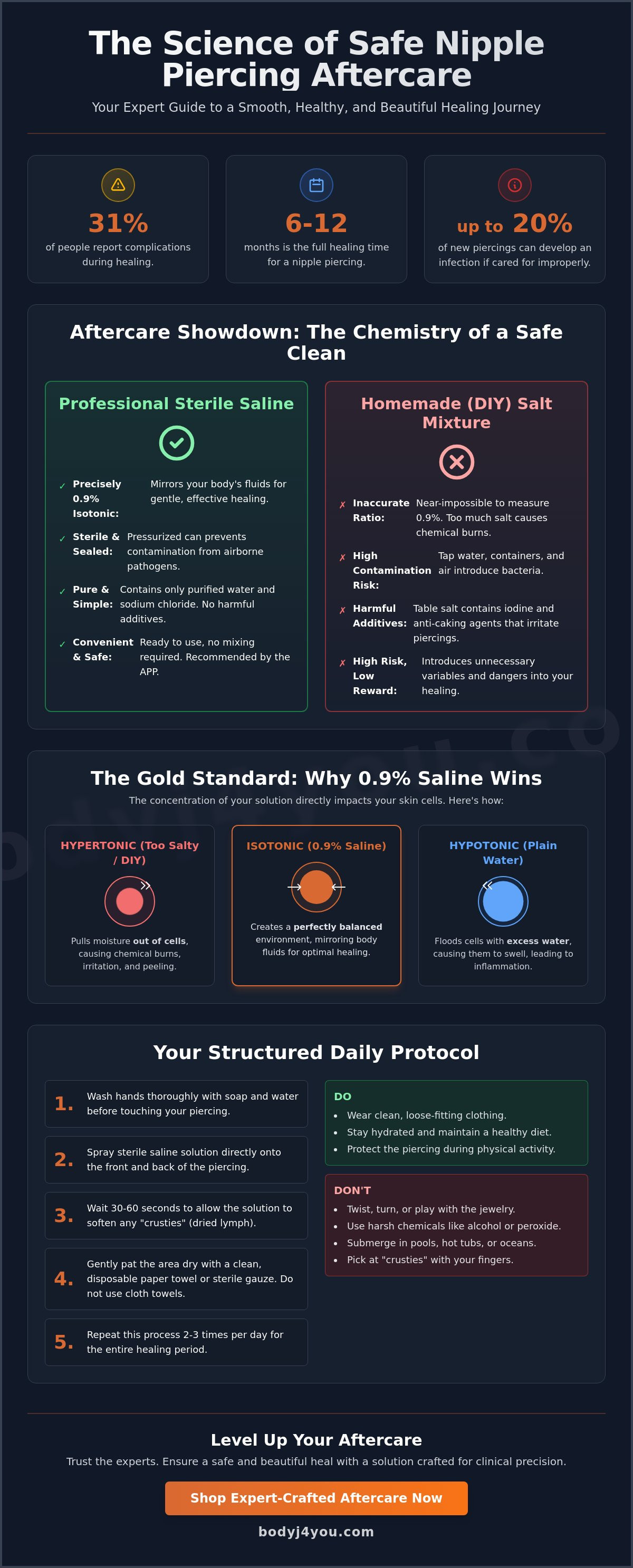
Follow this five-step protocol for your daily nipple piercing salt solution rinse to ensure your recovery is healthy, safe, and effective:
- Wash your hands thoroughly with antimicrobial soap for at least 20 seconds.
- Spray the sterile saline solution directly onto the entry and exit points of the piercing.
- Allow the solution to sit for 60 seconds to saturate and soften any dried lymph.
- Gently pat the area dry using a clean, disposable paper product.
- Ensure the area is completely dry before putting on breathable clothing.
Adhere strictly to the "No-Touch" rule. You should never rotate, twist, or slide your jewelry during a rinse. As established in our discussion of the fistula, your body is building a delicate skin tunnel around the metal. Rotating the bar breaks the internal seal of this tunnel, introducing surface bacteria into the wound and causing micro-tears. These tiny injuries often result in the irritation bumps that affect approximately 31% of people with body piercings.
The Saline Compress Technique
Cotton balls are often considered an "Aftercare Enemy" by professional specialists. Their tiny, loose fibers easily snag on the threads of your jewelry, causing irritation or even localized infection. Instead, use non-woven gauze saturated with your nipple piercing salt solution. For a five-minute warm compress, soak the gauze in warm sterile saline and hold it against the piercing. This method provides deep, targeted cleaning and is Crafted by Experts to be far safer than using fibrous cotton products.
The 'Shot Glass' Soak: Pro vs. Con
The traditional "Shot Glass" soak involves filling a small glass with saline and pressing it against the chest to create a vacuum. While modern piercers often prefer the convenience and sterility of sprays, a soak is still the best tool for softening stubborn, heavy deposits of lymph. If your jewelry feels "stuck" or the crusting is too thick for a simple spray to dissolve, a five-minute soak is necessary. Always ensure your glassware is sterilized before use to avoid cross-contamination. This balanced approach allows you to level up your care routine based on your body's specific needs at every stage of the journey.
Managing Nipple Piercing Complications: Bumps and Crusties
Encountering a bump on your new piercing can be alarming. It's often the first sign of physical vulnerability in your healing journey. Most of the time, these aren't infections but granulomas. This is a small, red, fleshy bump caused by friction, jewelry movement, or minor trauma. It's distinct from a keloid, which is a rare, genetic overgrowth of scar tissue that expands beyond the wound site. If you notice spreading redness, extreme heat, or thick green discharge, these are the primary signs of infection. In those cases, you must consult your professional piercer or a healthcare provider immediately.
A high quality nipple piercing salt solution acts as a stabilizing force during these flare ups. Through the process of osmosis, the isotonic saline draws excess interstitial fluid out of the swollen tissue. This reduces the internal pressure that causes discomfort and helps flatten irritation bumps. It's a gentle, clinical approach to managing the 31% of complications reported by those in the piercing community. By maintaining a clean environment, you allow the skin to focus on regeneration rather than defense.
We also advocate for the "LITHA" method: Leave It The Hell Alone. Beyond your twice daily saline rinse, your best strategy is to avoid all contact with the jewelry. Every time you touch, adjust, or check the piercing, you risk introducing bacteria and causing micro trauma. Trust your body's ability to heal itself when provided with a clean, stable environment. Your role is to be a wise guardian of your skin's integrity.
Dealing with 'The Crusties'
Seeing crusty buildup around your jewelry is actually a positive sign of progress. This is dried lymph fluid, a natural byproduct of your body repairing the fistula. However, removing them incorrectly can set your healing back by weeks. You should never pick at crusties with dry fingers. This causes micro tears in the healing skin and leads to permanent scarring or "piercing bumps." Always saturate the area with your nipple piercing salt solution first. Once the debris is soft and jelly like, you can gently wipe it away with a piece of non woven gauze.
When to Add Healing Oils
Once the initial inflammatory phase has subsided, you can level up your routine with targeted support. Natural options like Jojoba oil are excellent for maintaining skin elasticity and managing stubborn irritation. Jojoba is non comedogenic and mimics your skin's natural sebum, making it perfect for the sensitive nipple area. These oils should never replace your saline spray; they are secondary tools designed to nurture the skin after it has been cleaned. If you are looking to support your journey with professional grade ingredients, explore the BodyJ4You collection of healing oils to find the perfect match for your self expression.
The BodyJ4You Standard: Expert-Crafted Nipple Piercing Care
Your journey toward self-expression deserves a foundation of absolute safety. At BodyJ4You, we've spent twenty years refining the balance between clinical health and body art aesthetics. We understand that a nipple piercing is a significant investment in your personal style. Our saline aftercare is designed to protect that investment. It's healthy, safe, and effective. By choosing a professional nipple piercing salt solution, you're opting for a product that has been trusted by thousands of enthusiasts and professionals alike since our inception.
The "Born in the USA" label is more than a mark of origin. It's our shorthand for rigorous quality control and pharmaceutical-grade integrity. Unlike DIY mixtures that risk contamination, our saline spray is produced in controlled environments to ensure every mist is sterile. We use only pure ingredients that respect your body's biology. This commitment to purity ensures that your skin remains calm and resilient throughout the year-long healing process. It's aftercare that is Crafted by Experts. Trusted by Thousands. Rooted in Care.
Nurturing Your Self-Expression
We believe in the power of body modification to empower the individual. As your Supportive Specialist, we don't just provide products; we offer a stabilizing force for your skin's health. Our "Wise Guardian" approach means we prioritize the long-term integrity of your tissue over fleeting trends. We want you to feel confident in your recovery. Using professional tools allows you to level up your routine, ensuring that your piercings remain a vibrant part of your aesthetic for years to can come.
Your Next Steps: From Healing to Styling
Once your nipple piercing salt solution has helped you achieve a fully healed fistula, it's time to consider your long-term jewelry. The material you choose is just as vital as your aftercare routine. We recommend transitioning to high-quality materials like 14k gold or G23 titanium to prevent late-stage irritation. Surgical steel is also an excellent, durable choice for those with established piercings. If you find yourself inspired to explore further body modifications, you might enjoy The Ultimate Guide to Choosing and Using an Ear Stretching Kit in 2026.
Ready to ensure your healing process is as seamless as possible? Shop BodyJ4You Aftercare Solutions today and give your body the expert care it deserves.
Empower Your Healing Journey
Your nipple piercing is a bold statement of identity. Protecting that aesthetic requires more than just luck. It demands the clinical precision of a professional nipple piercing salt solution. You've learned why the 0.9% isotonic balance is superior to DIY mixtures and how the "No-Touch" rule protects your developing fistula. By prioritizing pharmaceutical-grade care, you eliminate the guesswork and focus on what matters most: a beautiful, irritation-free result.
BodyJ4You provides the stabilizing force you need during this vulnerable recovery period. We bring 20 years of industry experience to every bottle. Our saline solutions are proudly manufactured in the USA, ensuring you receive the highest standard of safety and quality. It's time to move beyond the uncertainty of home remedies and embrace a routine that is healthy, safe, and effective. Level up your aftercare and give your body the expert support it deserves.
Secure Your Healing with BodyJ4You Saline Aftercare
Your journey toward empowered self-expression is just beginning. We're honored to support you every step of the way.
Frequently Asked Questions
How often should I use salt solution on my nipple piercings?
Clean your nipple piercing exactly two times per day. This frequency maintains the "Golden Mean" of aftercare, providing enough irrigation to remove bacteria without drying out the skin. Over-cleaning can disrupt the 6 to 12 month healing process by stripping away the skin's natural protective barriers. Consistency is the key to a recovery that is healthy, safe, and effective.
Can I use contact lens saline for my nipple piercing?
No, you should never use contact lens saline for a piercing. These solutions often contain preservatives and buffers like boric acid or potassium chloride that are safe for eyes but irritate an open wound. Stick to a 0.9% sodium chloride nipple piercing salt solution that is free from all additives to ensure clinical precision during your healing journey.
What happens if I use too much salt in my DIY solution?
Using excess salt creates a hypertonic solution that causes chemical burns and extreme localized dehydration. A concentration higher than the recommended 0.9% pulls moisture out of your healing cells. This leads to peeling, redness, and the formation of the irritation bumps that affect 31% of people with body piercings. Precision is vital for protecting your skin's integrity.
Is it normal for my nipple piercing to bleed during a saline soak?
Minor spotting or bleeding during the first 14 days of healing is a common occurrence. However, if your piercing bleeds heavily during a rinse after this initial window, it may indicate physical trauma or a jewelry snag. If bleeding persists or is accompanied by sharp pain, consult your professional piercer to ensure the fistula hasn't been significantly damaged.
How do I know if my nipple piercing is infected or just irritated?
Irritation usually appears as a localized red bump, while infection involves systemic symptoms like spreading heat, extreme swelling, and thick green discharge. Approximately 20% of piercings experience some form of infection, so monitoring for fever or throbbing pain is essential. When in doubt, seek the guidance of a medical professional or your specialist to level up your safety.
Can I use sea salt from the grocery store for my piercing?
Grocery store sea salt is not a suitable substitute for pharmaceutical-grade saline. These products often contain anti-caking agents or trace minerals that can irritate sensitive nipple tissue and introduce non-sterile elements. Professional sprays are Crafted by Experts to ensure every application is pure, hypoallergenic, and free from the contaminants found in food-grade products.
Should I rinse off the salt solution after cleaning my piercing?
You do not need to rinse off the saline, but you must pat the area dry. Leaving the nipple piercing salt solution to air dry can occasionally lead to minor skin dryness in those with sensitive skin types. Use a clean, disposable paper product to gently remove excess moisture. This prevents the area from becoming soggy, which can trap bacteria against the wound.
How long do I need to keep using saline on my nipple piercings?
You should continue your saline routine for the entire 6 to 12 month healing duration. Even if the piercing looks healed on the surface, the internal fistula takes a minimum of 180 days to fully mature and stabilize. Maintaining your routine ensures your self-expression remains rooted in care from the first day until the final heal is complete.


