

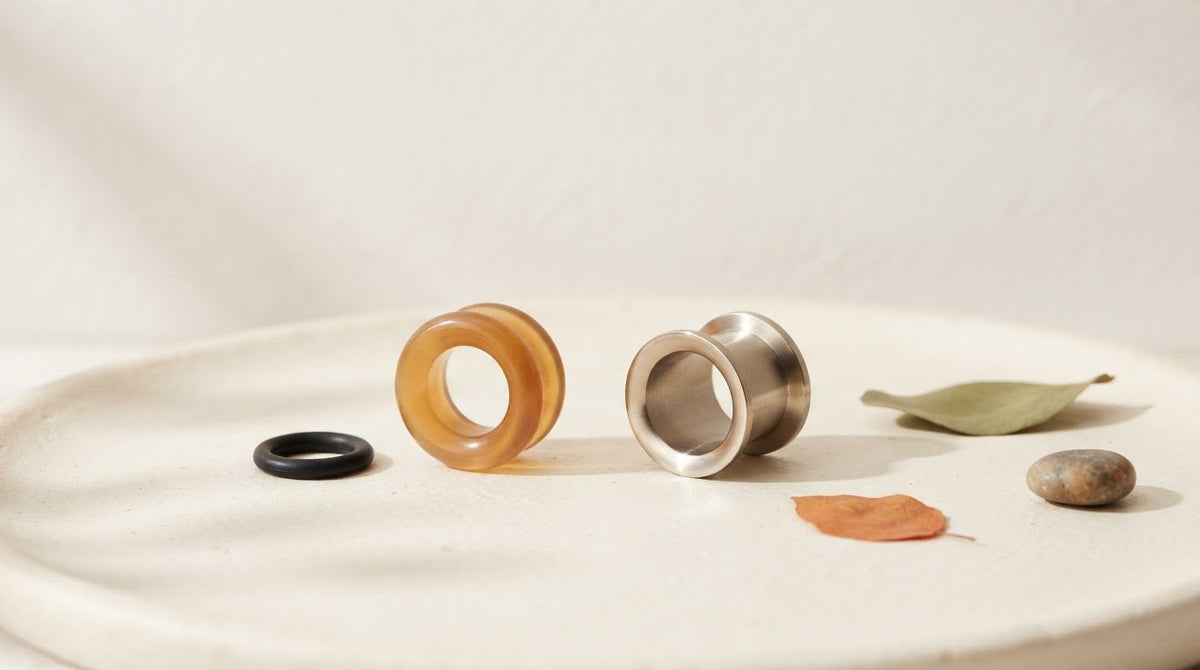
For single flare vs double flare plugs, choose a single-flare style when moving to a new size; its flared lip and smooth opposite end make insertion easier. A double-flare plug has lips at both ends and belongs in a settled, comfortably stretched piercing, not as a tool for stretching. Wear one only after your piercing has comfortably reached that gauge for at least 3 weeks.
It’s easy to see why choosing between single flare vs double flare plugs can feel confusing: double flares stay in place without an O-ring, while single flares are often easier to insert. The right fit depends on your stretching stage and how your ears feel, not just the jewelry’s appearance. Sensitive or still-adjusting lobes need extra care, and forcing a plug can cause irritation or injury.
This guide explains how the two flare styles differ, which may suit different stretching stages or sensitive ears, and how to ease a double-flare plug into a fully settled stretch. Use these points to choose jewelry that supports comfort as your style evolves.
Key Takeaways
- Match the flare style to your stretch stage: save double flares for a size that feels settled and comfortable.
- For sensitive ears, prioritize a gentle fit and never force a plug that resists insertion.
- Learn how the flare shape affects insertion, retention, and O-ring care before choosing your jewelry.
- Compare plug gauge with wearable length for fit, and explore an ear stretching kit when you’re ready to plan your next stage.
Choosing flare types for different stages of stretching
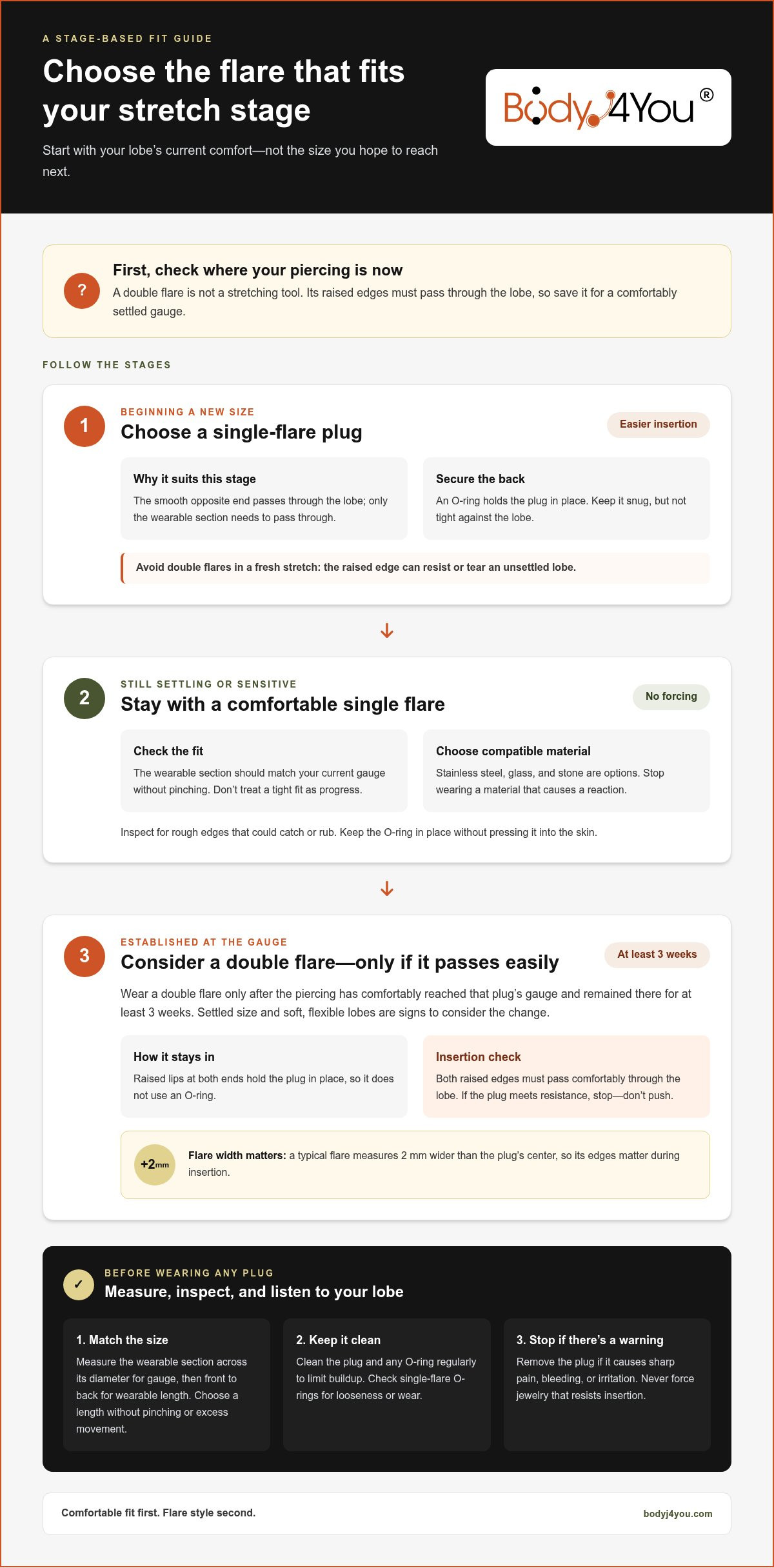
Choose a flare style based on your lobe’s current stage, not your next goal. A single-flare plug is usually the practical choice when moving to a new gauge. Its wearable section passes through the lobe, and the smooth end makes insertion simpler. An O-ring secures the back. Keep it snug, but not tight against the lobe.
For a fresh stretch, avoid double-flare jewelry. Its flared edges must pass through the piercing, so an unsettled lobe may resist or tear. Double-flare plugs aren’t stretching tools. Wear one only when the piercing has comfortably reached that plug’s gauge and stayed there for at least 3 weeks. A settled size and soft, flexible lobes are signs to consider the change.
To check the gauge and wearable length, measure the wearable section across its diameter, then measure its length from front to back. Match the gauge to your settled piercing size, and choose a wearable length that fits your lobe without pinching or allowing excess movement.
Use this stage-based guide:
- Beginning a new size: Choose a single-flare plug, and let the lobe adjust before changing styles.
- Still settling: Keep using a comfortable single flare; don’t treat a tight fit as progress.
- Established at the gauge: Consider double flares after the size has remained comfortable for at least 3 weeks.
Check a single-flare plug’s O-ring regularly. It can loosen or fall off, particularly with movement, so make sure it stays in place. Clean the plug and ring regularly to limit buildup that may cause discomfort. If the O-ring presses into the back of your lobe, loosen or reposition it.
With a double flare, the key question is whether both raised edges can pass comfortably through the lobe. If insertion meets resistance, stop rather than pushing. A flare that catches may mean your lobe isn’t ready, even if the center matches your current gauge.
Flare options for sensitive ears
For sensitive lobes, prioritize a smooth fit and a suitable material. Stainless steel, glass, and stone are options for plugs. Check material compatibility, since an allergy can irritate the ear or cause infection.
Double Flares in Newly Stretched or Irritated Ears
Double-flare plugs have raised edges on both ends, which must pass through the piercing. Avoid wearing them in newly stretched or irritated ears. A fresh stretch may not flex comfortably over the flares, and irritation can make insertion more difficult. Wait until the piercing has comfortably reached the plug’s gauge and remained at that size for at least 3 weeks. If the jewelry resists, don’t force it.
A single flare may be a gentler choice while a piercing settles because its smooth end passes through the lobe without a second raised edge. Keep the O-ring in place without pressing it into the skin.
Risks of Poor Fit and Unsuitable Materials
Poor fit means the jewelry presses, catches, or stretches the lobe during insertion or wear. A plug that’s too large can strain the piercing; one that’s too tight can press into the tissue and cause discomfort. Double-flare edges may tear a lobe if the piercing hasn’t reached the plug’s gauge. Stop if insertion causes intense pain or bleeding.
Material matters, too. Sensitivity or an allergy to a plug can irritate the ear, and irritation can increase infection risk. Choose stainless steel, glass, or stone, and stop wearing a material that causes a reaction.
Use these checks before wearing a plug:
- Check the fit: The wearable section should match your current gauge without pinching.
- Inspect the edges: Look for rough spots that might catch or rub the lobe.
- Watch the response: Remove the plug if it causes sharp pain, bleeding, or irritation.
With single flares, make sure the O-ring doesn’t press tightly against the back of the lobe. Clean the plug and O-ring regularly to reduce buildup that can cause discomfort. A comfortable fit and compatible material can make jewelry easier for sensitive ears to tolerate.
Differences between single-flare and double-flare plugs
A practical comparison of single flare vs double flare plugs starts with retention and insertion. A single-flare plug has one raised lip and usually a smooth opposite end, secured at the back with an O-ring. A double-flare plug has two hard lips, one at each end, and needs no O-ring.
That design changes how each plug enters and sits in the lobe. With a single flare, only the wearable section passes through, making insertion simpler. With a double flare, the lobe must flex over a raised edge. Once properly fitted, double flares are less likely to slip out. A typical flare measures 2 mm wider than the plug’s center, so its edges matter during insertion.
There’s no single fixed cost for either style. Price depends on factors such as material, design, and construction. Compare each plug’s details rather than choosing based on flare style alone.
Care differs, too. Clean the plug and any O-ring regularly to help prevent buildup that can cause discomfort. Check a single-flare O-ring for wear or looseness, since it can fall off. A double flare has no separate component, but clean its lips regularly, especially where the edges meet the wearable section.
- Single flare: One lip, a smooth opposite end, and an O-ring for retention.
- Double flare: Two raised lips that hold the plug without an O-ring.
- Insertion: The single flare’s wearable section passes through; the double flare’s edge must pass through too.
When choosing single flare vs double flare plugs, consider how you want the jewelry to stay in place and what your piercing can comfortably accommodate. An O-ring gives a single flare a removable retainer, while double flares rely on their shape. With either style, inspect the surface and edges before wearing it. Smooth, clean jewelry helps reduce friction and buildup; the flare design affects how the plug enters and stays in place.
What sizes and wearable lengths are available for single- and double-flare plugs?
Gauge describes the plug’s wearable diameter, the part that sits through the piercing. Wearable length describes the plug’s thickness from front to back. These measurements answer different fit questions: gauge matches the piercing’s size, while wearable length affects how the jewelry rests in the lobe.
Available gauges and lengths vary by design and material, so don’t assume every flare style comes in the same range. Read the item’s size details and distinguish the center measurement from the outer flare. The flare edge is wider than the wearable section, so its diameter doesn’t represent the gauge.
For a close fit, consider your lobe’s thickness and shape. A short wearable length may press against a thicker lobe, while excess length can let a plug shift, especially during movement. If the jewelry leaves a deep mark or repeatedly slides, its length may not suit your anatomy.
- Gauge: Match the wearable diameter to the piercing’s settled size, not the flare edge.
- Wearable length: Compare the plug’s front-to-back thickness with the lobe’s thickness.
- Flare design: Check that the flared edges can pass comfortably through the piercing before choosing double-flare jewelry.
Single- and double-flare styles can share a gauge but fit differently. Their flare shapes affect how the jewelry sits and inserts, but don’t change what the gauge measures. A correct center diameter alone can’t guarantee a comfortable wearable length. Check both measurements before choosing a plug, and reassess the fit if it pinches, catches, or shifts noticeably.
Choose by current fit rather than a future stretch target. If comparing sizing options, explore ear stretching jewelry options and use the listed gauge and wearable length as separate measurements.
BodyJ4You: Acrylic Ear Stretching Kit
BodyJ4You’s Acrylic Ear Stretching Kit is a product option for readers planning an ear-stretching progression. Use the flare guidance above to distinguish stretching jewelry from plugs intended to sit in an established stretch. Double-flare plugs aren’t stretching tools, so choose jewelry suited to your current stage and never force a size that resists.
A stretching kit may be relevant when you’re considering your setup. Before using stretching jewelry, match the size to your current piercing and proceed only if the fit is comfortable. If your ears are irritated, pause rather than pushing ahead. Careful sizing and patient progression keep comfort central to your decisions.
Visit BodyJ4You to explore the Acrylic Ear Stretching Kit.
Choose your next step with care
Let your next jewelry choice reflect where your ears are now, not where you hope they’ll be later. Choosing between single flare vs double flare plugs is an opportunity to prioritize comfort while expressing your personal style. Take time to choose thoughtfully, without treating a new size as a deadline.
If you’re planning your stretching setup, BodyJ4You offers the Acrylic Ear Stretching Kit and Surgical Steel Taper and Plug Kit. The Saline Piercing Aftercare Spray is another option for piercing aftercare. Choose products that fit the stage you’re at, and keep comfort central as your style evolves.
Contact BodyJ4You for help choosing your next step, and keep building your look with care and confidence.
Frequently Asked Questions
Double Flare vs Single Flare: Which Plugs Are Right for You?
Choose a single flare if your piercing is adjusting to a new size or you prefer easier insertion. Choose a double flare for an established stretch that comfortably accommodates both edges. If a plug catches as you put it in, choose a style that doesn’t require the lobe to pass over two raised ends. Let comfort guide your choice, not appearance alone.
What is a Flare (for stretched ears)?
A flare is the raised rim at a plug’s end that helps keep the jewelry from sliding through a stretched lobe. The wearable section sits inside the piercing, while the flare extends beyond it. For example, the front rim may be wider than the center, so the center gauge alone doesn’t tell you how easily the edge will pass through.
What are single-flare and double-flare plugs?
Single-flare plugs have one raised end and typically use a removable O-ring to secure the other side. Double-flare plugs have raised ends on both sides, so their shape keeps them in place. A no-flare plug is another style: it has a straight cylindrical shape and uses O-rings at both ends to hold it in place.
What is the difference between single-flare and double-flare plugs?
The main difference is retention and how the plug enters the ear. A single-flare design uses an O-ring, which needs occasional attention because it can loosen or go missing. A double-flare design has no separate ring to manage, but both raised edges must pass through the piercing. Consider which feature best suits your routine and current fit.
Which is safer or more comfortable: single-flare or double-flare plugs?
Neither style is automatically more comfortable for everyone; fit and stretching stage matter. A single flare can be easier to manage while a piercing is adjusting, while a double flare suits a settled stretch that accepts its edges comfortably. Stop if jewelry causes intense pain or bleeding. A plug that slides, pinches, or presses against the lobe isn’t a comfortable fit.
How do you insert and remove single-flare versus double-flare plugs?
For a single flare, remove the O-ring, guide the smooth end through the piercing, then replace the ring without pressing it into the lobe. For a double flare, guide one edge into the opening, gently pull the lower lobe down, and ease the upper edge into place. To remove either style, reverse the movement gently. Never force a plug that resists.


